

One of the things that I’ve been thinking about is the idea that physicians need better side projects in healthcare. The problem is that in medicine, side projects equals side gigs, and a faster track to early retirement. People think that you need to have a short-term rental business or a locums job as a side gig rather than just doing things to solve problems, even if they’re not profitable yet.
Part of the reason why this mentality the de facto standard is because it’s easy to default into things that have been done in the past, and paths that are well trodden. I can imagine going into a locums gig to increase my compensation, but I can’t imagine the path to become a health tech leader. The contrary view is often the most overlooked view, and we doctors are a risk-averse bunch. We also, for the most part, have crushing loans which we’re trying to pay off, which further dampens risk-seeking because it’s more lucrative to stay in medicine than leave it (see: golden handcuffs). For all these reasons, most people equate side projects to side gigs.
A lot of doctors also don’t have time or the bandwidth to keep up with the latest and greatest tech that’s coming out in the healthcare sphere. And honestly, I believe it. I think that part of the reason that doctors are so averse to technology is 1) they think of tech as an affront to the way of practicing that they’ve done for so long (often more than three to seven years of residency), or 2) they think that it will just add more work for them rather than reducing their workload.
I think that’s changing, though, with the new class of physicians. Young physicians realize that there’s a lot of opportunity in the world, and medicine is changing. They’re using OpenEvidence, and they’re eschewing up-to-date. They’re also finding that more knowledge is on the fingertips of patients, through ChatGPT Health and Superpower. So, they need to act in a way that’s focused on being a healer / guider rather than a person in an ivory tower shouting down commands on what to do or what not to do.
I think that doctors need to change the way they think about careers too. Gone are the days where you could just start a private practice (can you even start one anymore?) and the outcomes of those patients aren’t on your head: it was just patient in, patient out. Now, physicians need to take on more risk for payment, which causes increased annoyance.
Doctors of the past had the unique advantage of living in a world where things move slowly. Regulatory moats were able to set in stone the way that they practiced. As we enter into a more personalized medical era where patients are more empowered when answering questions using AI sidekicks and AI scribes, It becomes harder for physicians (and providers writ large) to ignore innovation. In fact, as the AMA considers innovative CPT codes (i.e., RPM, digital pathology, AI radiology), providers are forced to pay attention. It might even be considered malpractice in 20 years to not use AI in diagnosis.
Between competencies, curriculums, and rule by committee, there is an aspect of conservatism that is needed in in medicine. Without the foresight on how to intentionally improve technology, I can see how the excitement over AI disrupting healthcare can be misplaced. I also can understand the want of medical educators to focus on training of good doctors to treat patients, ones who are empathetic and also invested in their patients, rather than just looking at them as another RVU. I think patients are starving for this as well. But the world, unfortunately, moves faster than yet another committee formation and approval.
As a resident physician, I think that there’s a huge benefit in having a side project, as working on things outside of medicine can really bring joy to your own life. One way I’ve done that recently is by solving real problems in my own life and practice. Vibe coding has really helped me, as a non-technical person, get involved in creating and interacting with technology systems that we use regularly in healthcare.
For example, in pathology, we routinely get samples but it’s hard to track the hospital. And as a pathologist, you don’t really account for it when you’re thinking about revenue cycle management and staffing levels in the lab, your workflow is just signing out your samples and coordinating with the clinical team and go home. So I decided to solve my own problems by going to a hackathon, and along with my very bright team, getting to a minimum viable product (MVP) to solve this problem of tracking pathology samples in the lab.
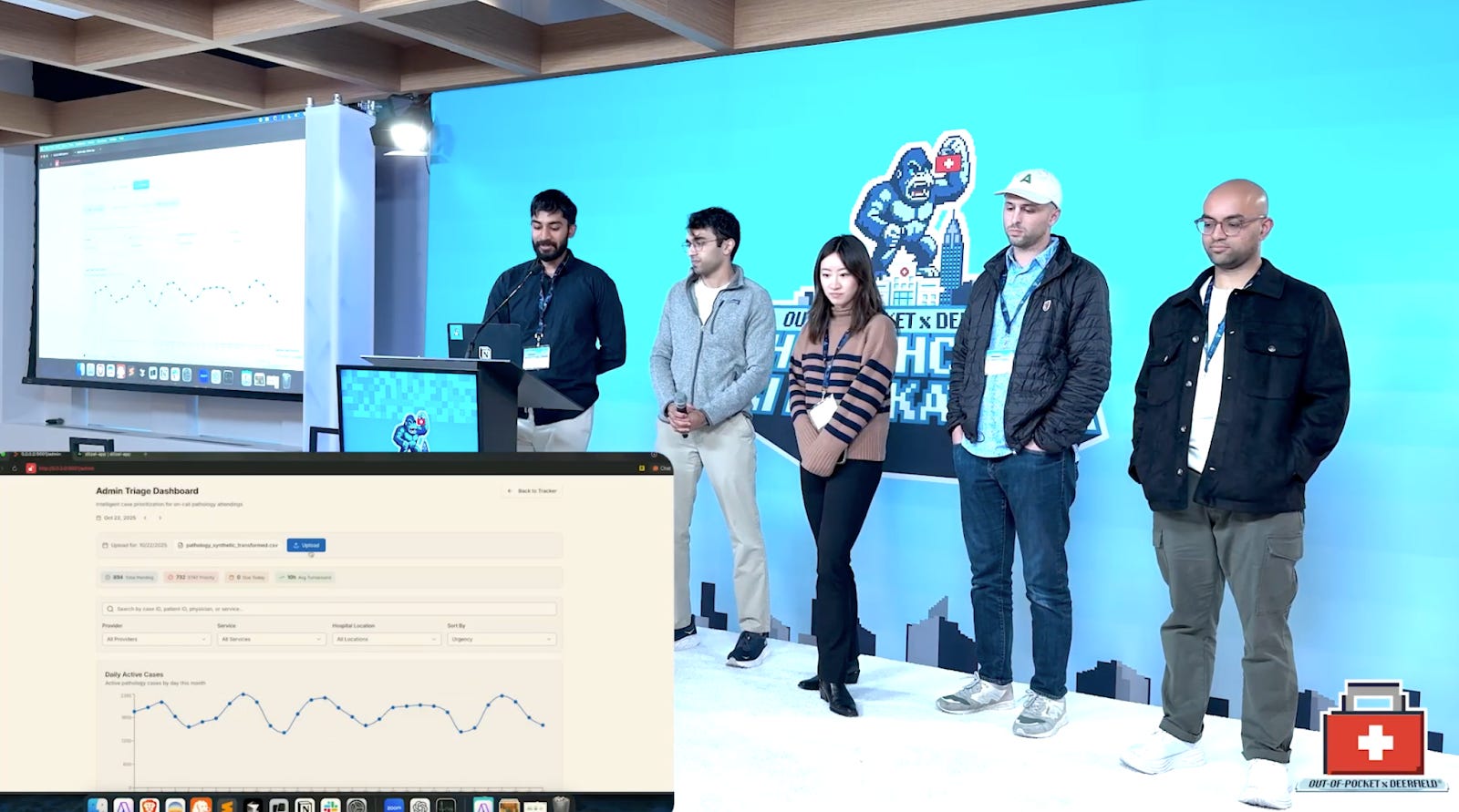
So I think more doctors should understand how to vibe code, partially because they’ll find that they can solve bad systems through their own ingenuity. Plus, it’s a ton of fun just trying to solve problems that we have in the hospital or clinic. Operations through quality improvement becomes a lot more tangible when you actually feel like you’re doing something rather than studying and putting out an abstract or publication which doesn’t change anyone’s behavior.
Clinicians have a unique view in health care and it’s important to leverage that. But, the environment still needs to be de-risked for clinicians to feel comfortable enough to leave their jobs of a stable career in order to take the risk and plunge into non-clinical options. When I was talking with a friend about a choice to accept a product management internship versus pursuing residency, the age-old question came up about potentially leaving your golden handcuffs on the table and preventing yourself from advancing through what would be the final stage of your bondage in the medical education realm.
But with side projects, pursuing interests in both fields becomes more feasible. Coding isn’t a full-time job anymore and weekend projects are the norm. With tools such as Spokenly, Cursor, Claude, and ChatGPT, you can create an app end-to-end in a weekend. Clinicians have the expertise and now they’ve been given the tools to unleash their creativity in a clinical system which is often regimented and devoid of acceptance for anything but the norm.
People will disagree with me and say that clinicians have always had the ability to do side projects, such as writing. But I would argue that this time is different. This time it feels more tangible. I think that all physicians have the ability to enact change not only at an individual level, but also a systemic level, through changing the systems that we interact with every day. I hope in the future I can write more about the side projects that I’ve been doing and also around the interest that I have in healthcare. I think that using these tools, my creativity has been unleashed and I feel empowered once again.